Penis Envy (PE)
Amazonía Colombiana / Norteamérica (Intervención de T. McKenna / R. McPherson)
Morphology and Mutations
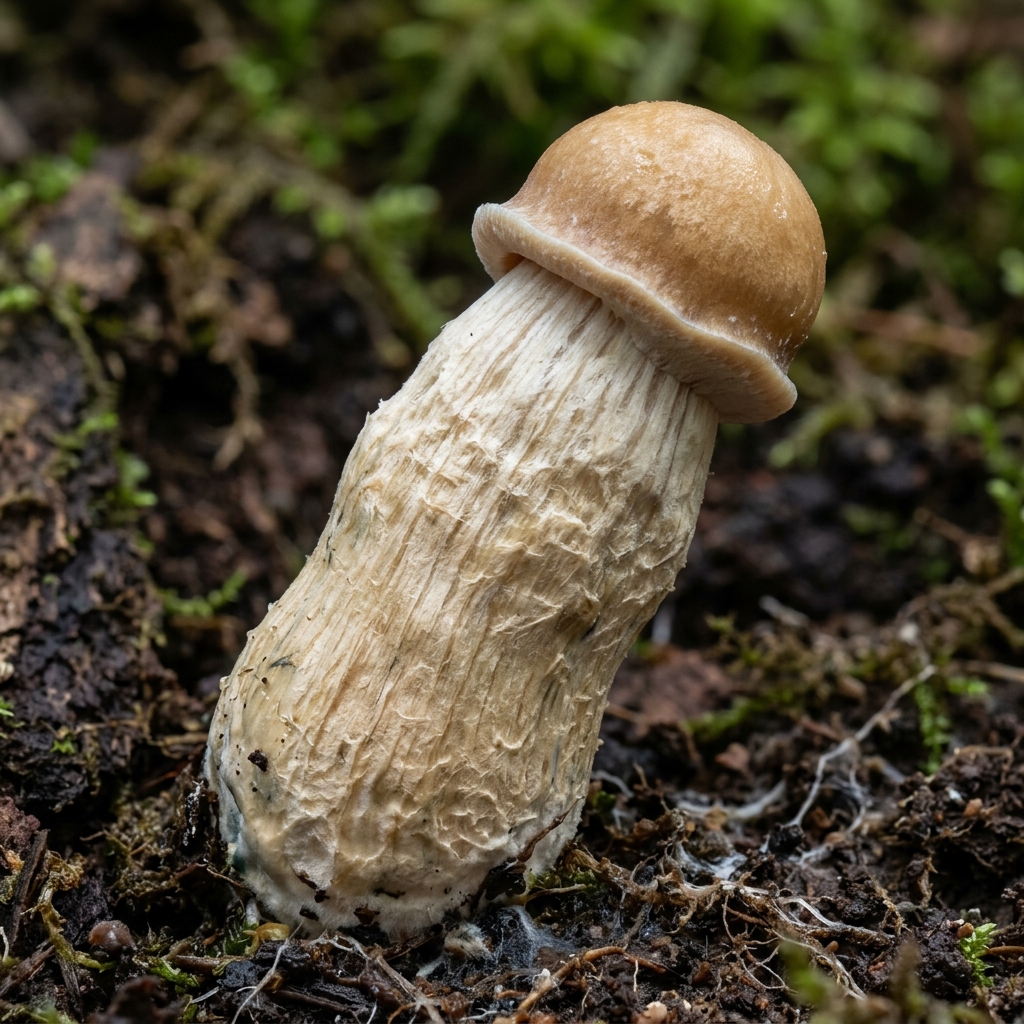
Cap (Pileus): Pileus bulbous, poorly developed, often does not fully separate from the stipe. Lacks a differentiated partial veil.
Stipe (Stem): Stipe hypertrophic, excessively thick, fleshy, with a dense and fibrous consistency.
Spores: Extremely scarce (oligosporic). The <span data-tooltip="Fertile part of the fungus where spores are produced (e.g. gills)" tabindex="0">hymenium</span> rarely expels viable spores in significant quantities.
Genetic Traits: Phallic (developmental anomaly), Oligosporia, Extreme tissue density, Delayed maturation
Cultivation Characteristics
Special Requirements: It absolutely requires a biologically active or pH-balanced casing layer to induce primordia formation. Highly susceptible to variations in relative humidity; the formation of anomalous bodies or "blobs" is common in the first flush without a rigorous microclimate.
Effects and Psychopharmacology
- Intense visuals with closed eyes
- Strong temporary alteration
- Mystical experience
History and Description
Penis Envy (PE) is, without a doubt, the most infamous and influential morphological mutation in the history of P. cubensis cultivation. Its genesis is attributed to spores collected in the Amazon basin by ethnobotanist Terence McKenna, subsequently isolated and generationally selected by mycologist Steven Pollock and Richard McPherson (code "RichGee"). The strain exhibits extreme pleomorphism where the stipe accumulates almost all of the fungal biomass, while the <span data-tooltip="The cap or top part of the mushroom" tabindex="0">pileus</span> remains atrophied. This anomalous morphology inhibits normal sporulation, requiring collection via sterile swabs from the hymenial tissue. Biochemically, liquid chromatography (HPLC) studies have documented psilocybin and psilocin concentrations up to two or three times higher than the species average, which is consistent with its exceptional tissue density.
The Penis Envy (PE) variety has an extensive history in modern mycology, being appreciated for its unique genetic profile and its contribution to fungal biodiversity studied in laboratories worldwide.