Technical Guide: Pasteurization Methods and Substrate Formulation
Substrate preparation is the fundamental cornerstone of applied mycology. Unlike grain spawn production where absolute sterility is required, treating fruiting substrates relies upon microbiological equilibrium and ecological selectivity.
In a Nutshell: The Law of Ecological Selectivity
Sterilizing at 121 °C creates a defenseless "blank slate" vulnerable to airborne mold spores (such as Trichoderma). In contrast, controlled pasteurization between 65 °C and 75 °C eliminates competitors, nematodes, and plant pathogens while keeping actinobacteria and beneficial thermophilic bacteria (Bacillus subtilis) alive to consume free sugars and form an active biological shield. Exceeding 82 °C annihilates this shield, leaving the substrate defenseless.
1. Biological Fundamentals: Pasteurization vs. Sterilization
The distinction between these two thermal processes is ecological rather than purely thermodynamic.
Sterilization (121 °C @ 15 PSI)
Exclusive to Inoculum / Grain SpawnReserved exclusively for nutrient-dense endosperm grain (rye, wheat, millet, corn) and heavily supplemented mixes (>20% bran or seed meals).
Pasteurization (65 °C – 75 °C)
Standard for Bulk Fruiting SubstratesThe gold standard for lignocellulosic materials: coco coir, agricultural straw, unsupplemented hardwood sawdust, and aged manures.
device_thermostat Thermal Spectrum of Mycological Pasteurization
2. DIY Home Protocols for Cultivators
Reliable and reproducible protocols requiring no expensive industrial equipment or laboratory autoclaves.
Bucket Tek (Thermal Infusion Pseudo-Pasteurization)
Optimized for Coconut Coir, Vermiculite & Gypsum (CVG Formula)Due to the low free-carbohydrate profile of coconut coir, this thermal holding method is remarkably reliable. While technically an infusion blanching rather than a ramped pasteurization, it represents the global benchmark for growing Psilocybe cubensis and natalensis.
menu_book Golden Ratio for a Standard Brick
Bucket Loading
Break up the dry 650 g coir brick inside a clean 20-liter food-grade plastic bucket. Add 2 liters of vermiculite and 1 cup of gypsum.
Boiling Water Infusion
Bring 3.75 liters of clean water to a vigorous rolling boil. Immediately pour the boiling water evenly over the dry ingredients.
Immediate Airtight Seal
Snap the bucket lid on tightly to trap all thermal steam. Shake or stir with a sanitized paddle for 30 seconds to distribute moisture evenly.
Passive Insulation (12 - 24 Hours)
Wrap the bucket with thick thermal blankets or insert into a sleeping bag. This holds core heat above 65 °C for hours and ensures slow cooling below 28 °C before spawning.
Hot Water Bath / Atmospheric Steam (True Pasteurization)
Mandatory for Manure, Straw, or Supplemented MixesWhen bulk substrate contains nitrogen-rich components or free starches (horse manure, straw, or compost), simple boiling water infusion is inadequate. A monitored water bath maintains continuous thermal holding at the biological core.
Breathable Bagging
Hydrate the substrate to exact field capacity. Load into polypropylene filter patch bags (0.2–0.5 micron Unicorn bags) or loosely lidded glass jars.
False Bottom Setup
Place a trivet or folded towel at the bottom of a large stockpot so bags never make direct contact with conductive bottom heat. Fill with water to one-third container height.
Core Probe Telemetry
Insert a sanitized digital probe thermometer into the geometric core of a center bag. Start your timer only when the core reaches 65 °C.
Holding Plateau: 90 to 120 Minutes at 65 °C – 75 °C
Regulate heat to maintain steam. Never allow the core temperature to exceed 75 °C. Turn off heat and let cool inside the pot to <28 °C before opening.
Cold Chemical Pasteurization with Hydrated Lime
Zero Thermal Footprint | Benchmark for Straw and Pleurotus (Oyster Mushrooms)This method swaps heat for extreme alkaline shock. A temporary surge in water pH lyses competitor cell membranes while preserving straw lignocellulose. It is ideal for bulk straw preparation when growing oyster mushrooms (Pleurotus ostreatus, eryngii, djamor).
Low-Magnesium Hydrated Lime Selection
Use only pure hydrated lime (Calcium Hydroxide, Ca(OH)2) with less than 2% Magnesium. High-magnesium builder's lime (dolomitic lime) stunts fungal mycelium growth.
Dissolution and Alkalinization (pH 12 - 13)
Dissolve 2 to 4 grams of hydrated lime per liter of cold tap water in a drum or barrel. Stir thoroughly and verify with pH strips or a digital meter that pH exceeds 12.
Full Straw Submersion (12 to 16 Hours)
Chop straw to 5–10 cm lengths and submerge completely using clean weights. Ensure no straw floats exposed to air. Soak for 14 hours.
Drainage & CO₂ Self-Neutralization
Hang straw vertically to drain for 60 to 90 minutes until field capacity is reached. Ambient carbon dioxide naturally reacts with hydroxide to form calcium carbonate, neutralizing pH to mushroom-friendly levels.
3. Industrial & Commercial Scale Methods
High-throughput installations engineered for commercial mushroom farms and modern mycology facilities.
Immersion Drum System
Common in mid-scale farms to process between 100 and 500 kg of chopped agricultural straw per continuous batch.
- Setup: 500 to 1000-liter stainless steel tanks equipped with industrial gas burners or submerged 3-phase heating elements.
- Thermal Regime: Water preheated to 72 °C; straw cages lowered to maintain 65 °C – 70 °C for 60 to 90 minutes.
- Drain & Clean Room Cooling: Rapid-discharge valves and clean room stainless steel transfer tables for aseptic spawning.
Atmospheric Bulk Steam Chamber
The ultimate high-volume standard for processing bulk substrate mounds or thousands of filter bags simultaneously.
- Thermal Ramp (2-4 h): Heavy steam injection until core telemetry probes register 70 °C across all cold spots.
- Holding Plateau (6-12 h): Strict maintenance between 70 °C and 75 °C with variance under ±1.5 °C.
- HEPA Pressurized Cooling: HEPA H14 filtered air is injected during cooldown to eliminate vacuum condensation back-siphonage.
4. Substrate Formulation Matrix by Species
Nutritional demands, base materials, tolerated supplements, and recommended treatment protocols per species.
| Species | Base Substrate | Optimal Supplementation | Treatment Method | Key Parameter / Regime |
|---|---|---|---|---|
| Psilocybe cubensis / natalensisCoprophilous / humus saprophyte | Coconut Coir (CVG) | Vermiculite (30%) + Gypsum (5%) + Manure (10% optional) | Bucket Tek / Water Bath | 68 °C – 74 °C (12-24 h passive hold) |
| Pleurotus spp. (Oyster, Pink, King)Aggressive primary lignicole | Wheat/barley straw or spent coffee grounds | Wheat bran (0 - 10% max) | Cold Hydrated Lime or Hot Soak | pH > 12 for 14 h / Water at 68 °C for 90 min |
| Hericium erinaceus (Lion's Mane)Hardwood xylophage | Hardwood sawdust (Master's Mix) | Soybean Hulls (50% sawdust / 50% soy hulls) | Sterilization Mandatory | 121 °C @ 15 PSI for 150 min (protein-rich matrix) |
| Lentinula edodes (Shiitake)Slow secondary lignicole | Non-resinous hardwood sawdust (oak/beech) | Rice/wheat bran (15-20%) + Gypsum (1%) | Sterilization Mandatory | 121 °C @ 15 PSI for 120-150 min in filter patch bags |
| Agaricus bisporus (Button / Portobello)Secondary compost decomposer | Fermented compost (straw + horse manure) | Cottonseed meal, agricultural gypsum, urea | Phase II Steam Tunnel | 58-60 °C (pasteurize) + 48-52 °C (ammonia conditioning) |
5. Field Capacity: The Critical Water Metric
Moisture content dictates the boundary between explosive fruitbody production and anaerobic decay.
Optimal Result (Field Capacity)
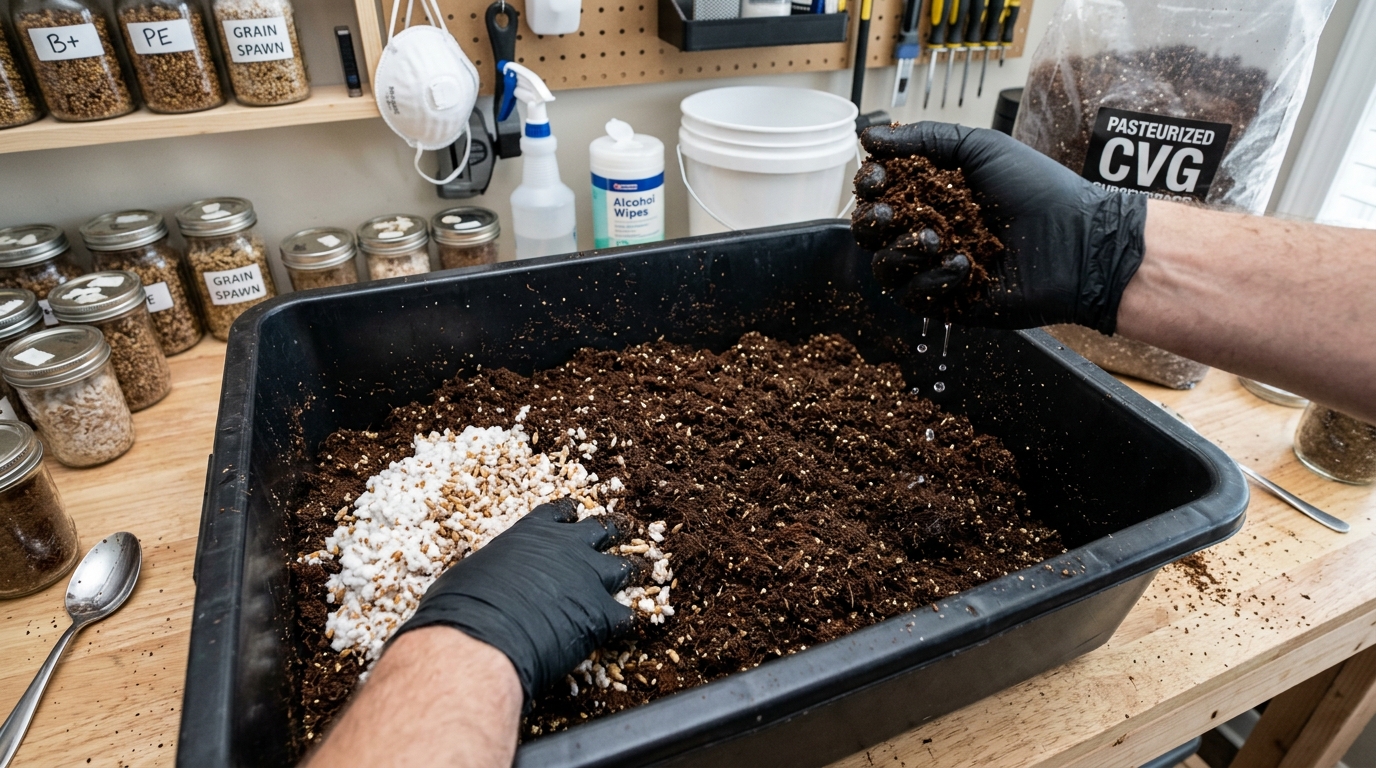
With an open, relaxed hand, not a single drop should fall. When closing your fist and applying maximum squeeze pressure, exactly 2 to 4 continuous drops should drip between your knuckles.
Under-Hydrated (Dry Substrate)
Under maximum squeezing force, no moisture emerges. The substrate crumbles into dry powder or brittle flakes when opening your hand.
Over-Hydrated (Waterlogged)
Water gushes in a continuous stream with minimal hand pressure, or pools visibly at the bottom of the container.
6. Substrate Pathology & Contamination Triage
Early biological diagnostic symptoms, immediate containment actions, and inoculation rules.
Bacillus spp. (Wet Spot / Sour Rot)
Trichoderma harzianum
Dactylium dendroides / Cladobotryum
Hot Inoculation Lethality
7. Technical Frequently Asked Questions
Engineering answers to recurring substrate preparation and pasteurization queries.
Pressure cooking at 15 PSI wipes out 100% of biological life, leaving an unprotected sterile medium. Unlike grain spawn, bulk fruiting tubs are handled in open rooms full of airborne mold spores. Without the active ecological competition provided by thermophilic bacteria (Bacillus subtilis) and actinobacteria, opportunistic Trichoderma spores will germinate and colonize the substrate ten times faster than mushroom mycelium.
Above 82 °C, beneficial thermophilic microflora undergo cellular lysis and denaturation. The substrate loses its innate biological shield and becomes vulnerable to post-cooling contamination. Always modulate heat to keep core temperatures between 65 °C and 75 °C.
No. Conventional construction lime often contains high ratios of magnesium (dolomitic lime). High magnesium levels poison fungal mycelium and severely stunt colonization. Always source pure horticultural Hydrated Lime (Calcium Hydroxide) certified with less than 2% Magnesium.
For beginners or ambient home growing, a volumetric ratio of 1:1 to 1:2 (e.g., 1 quart colonized grain to 1.5–2 quarts CVG) ensures rapid consolidation in 5 to 7 days, narrowing the contamination window. Advanced cultivators with laminar flow hoods often utilize 1:3 to 1:4 to maximize total flush yields per volume of grain.
Thoroughly wash the bucket with warm soapy water, followed by a heavy misting of 70% isopropyl alcohol or a 10% diluted bleach rinse (air dried). While boiling water scalds the interior surfaces, pre-sanitizing eliminates stubborn bacterial colonies in the rim crevices and lid seals.