Base de Datos Taxonómica
Clasificación botánica completa de los hongos psicoactivos.
Clasificación Evolutiva
"Understanding taxonomy is unravelling the phylogenetic tree of consciousness."
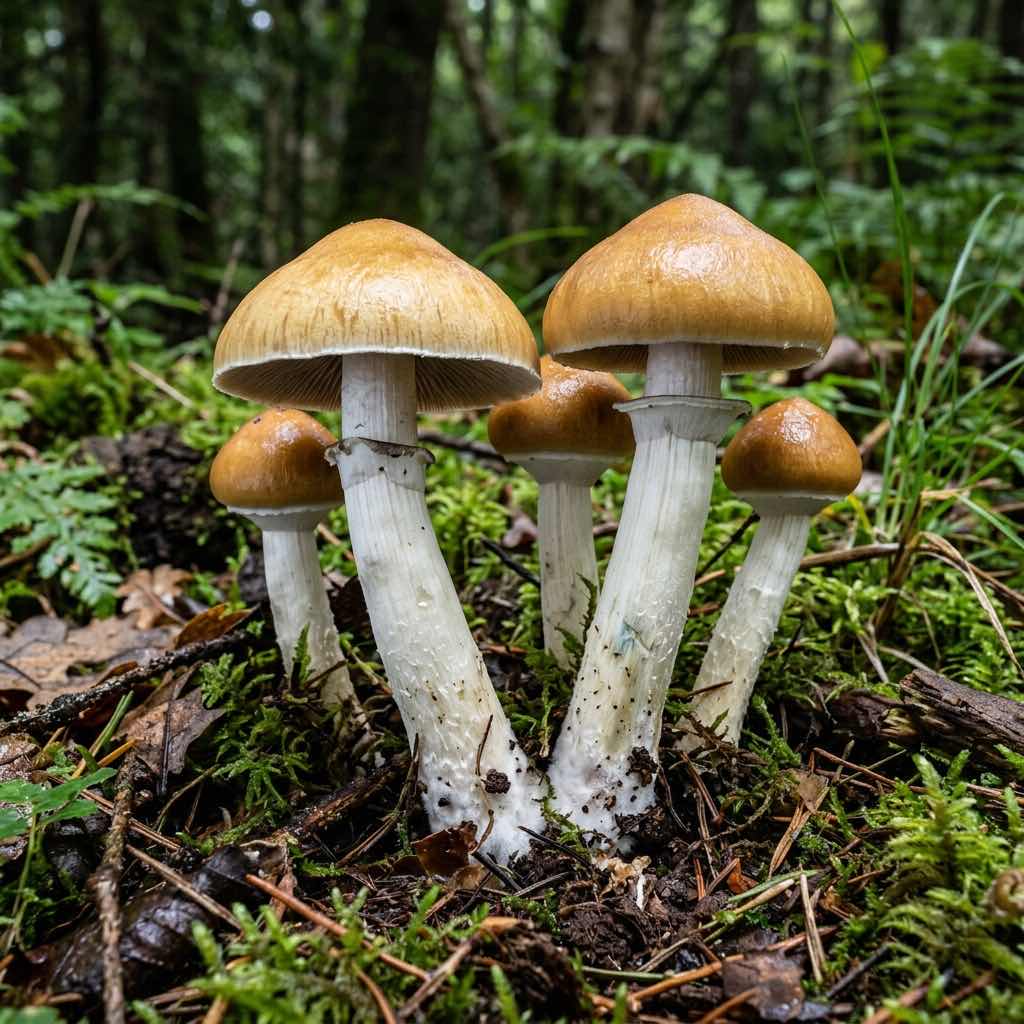
Wild Species Gallery
AI generated botanical images
Sin resultados
No species found matching the current filters.
Botanical Context & Species Diversity
Psilocybin vs Muscimol
There is common confusion between the genera Psilocybe and Amanita (specifically Amanita muscaria, the iconic red mushroom with white spots). It is critical to understand that Amanita muscaria does not contain psilocybin. Its active principles are muscimol and ibotenic acid, which act on GABA receptors (not on serotonin 5-HT2A receptors). Amanita's effects are dissociative, deliriant and its toxicity is considerably higher. In contrast, psilocybin mushrooms (like Psilocybe) are classical serotonergic agonists with a substantially higher physiological safety profile.
Beyond Psilocybe
Although Psilocybe cubensis is the most famous species due to its ease of in-vitro cultivation, the genus Psilocybe includes over 100 psychoactive species. However, psilocybin biosynthesis is not exclusive to this genus. Convergent evolution has enabled other genera to produce these alkaloids:
- Panaeolus: (e.g. P. cyanescens) Known to be among the most potent in the world, favoring dung-rich substrates.
- Gymnopilus: Wood-decaying species that often contain variable proportions of psilocybin and bitter compounds.
- Pluteus & Conocybe: Less common species, some of which contain trace levels of tryptamine alkaloids.
The Alkaloid Profile
Potency and journey character depend not only on species, but on their alkaloid profile, known as the entourage effect:
- Psilocybin: An inactive prodrug. The most stable compound during storage.
- Psilocin: The active metabolite. Highly unstable when exposed to oxygen (causing the blue bruising). Responsible for immediate effects.
- Baeocystin & Norbaeocystin: Demethylated analogs. Modulate bioavailability and trip duration. Species like P. baeocystis contain high levels.
Catalog Focus
Why don't we document all 200+ active species? We apply a filter of clinical relevance and cultivable prevalence. We thoroughly document the P. cubensis complex (and its mutant isolates) alongside the most thoroughly researched Psilocybe and Panaeolus species. Listing hundreds of obscure, uncharacterized endemic Little Brown Mushrooms (LBMs) increases foraging risks without adding clinical utility.
Cubensis Strains & Hybrids Catalog
AI generated botanical images
Catalog of genetic isolations, commercial mutations of Psilocybe cubensis and Magic Truffles (Sclerotia).
No results
No strains found matching the current filters.