McKennaii
Cepa de Origen Holandés (Laboratorio Comercial)
Morphology and Mutations
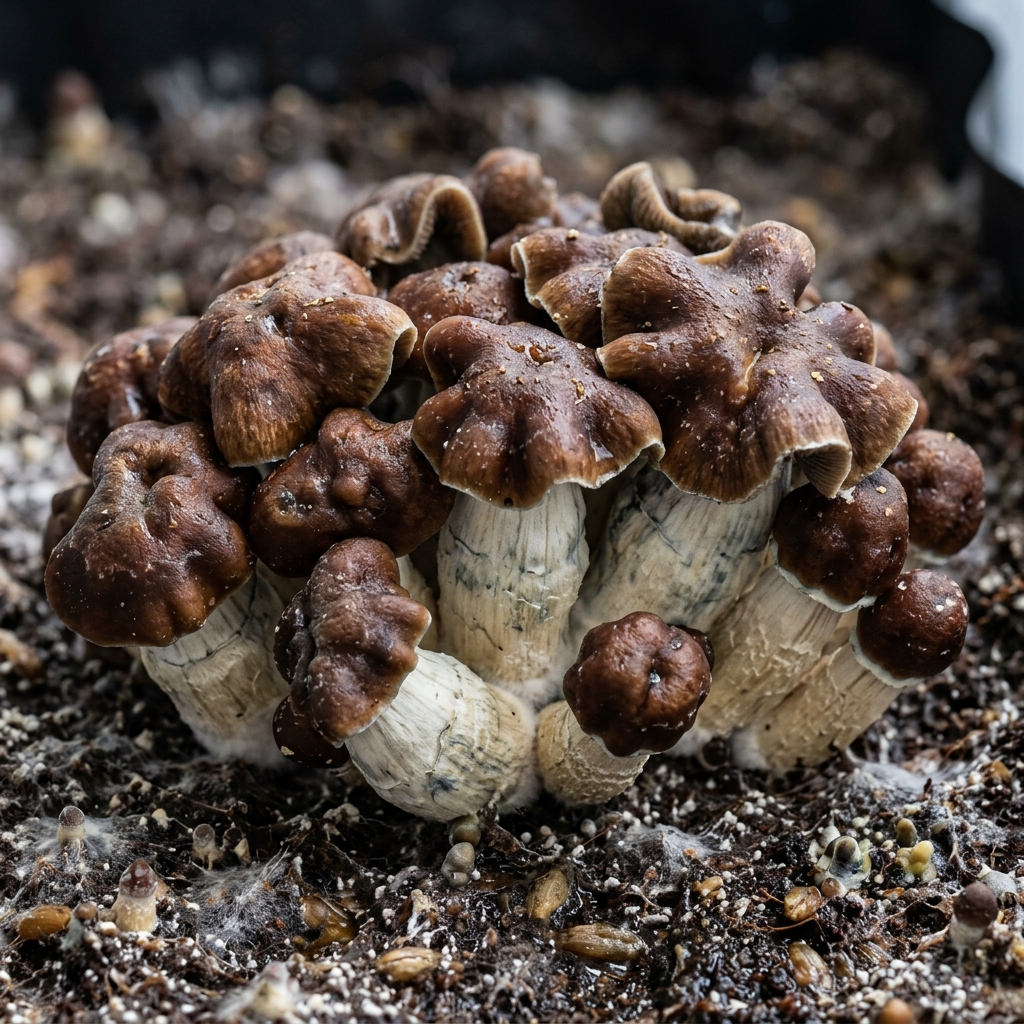
Cap (Pileus): Multiple asymmetric, wavy, or markedly deformed caps. Dark and dense pilei.
Stipe (Stem): Disproportionately thick in relation to its height. Short and deformed.
Spores: Late sporulation, scarce in very anomalous specimens.
Genetic Traits: Alien/Anomalous Morphology, Dense cluster growth, Fibrous stem
Cultivation Characteristics
Special Requirements: Dense fruiting clusters (massive pinsets) demand excellent gas exchange (FAE) to prevent localized necrosis due to interfacial moisture accumulation within the clusters.
Effects and Psychopharmacology
- Vivid fractals
- Profound euphoria
- Significant sensory alteration
History and Description
Despite popular belief and the honorary nomenclature, the McKennaii strain was not isolated or discovered by the legendary ethnobotanist Terence McKenna; it was commercially created in the Netherlands shortly after his passing as a tribute to his memory. This designer genetic was meticulously selected to maximize the alkaloid profile and to exhibit unusual morphology. Its fruiting bodies tend to form extremely dense "clusters" or massive agglomerations, where individual sporocarps undergo mechanical compressions resulting in alien shapes, asymmetrical caps, and stunted stems. It is widely praised in the European smartshop scene for its notorious psychoactivity.
The McKennaii variety has an extensive history in modern mycology, being appreciated for its unique genetic profile and its contribution to fungal biodiversity studied in laboratories worldwide.