Golden Teacher
Desconocido (Registrada comercialmente a finales de los 1980s)
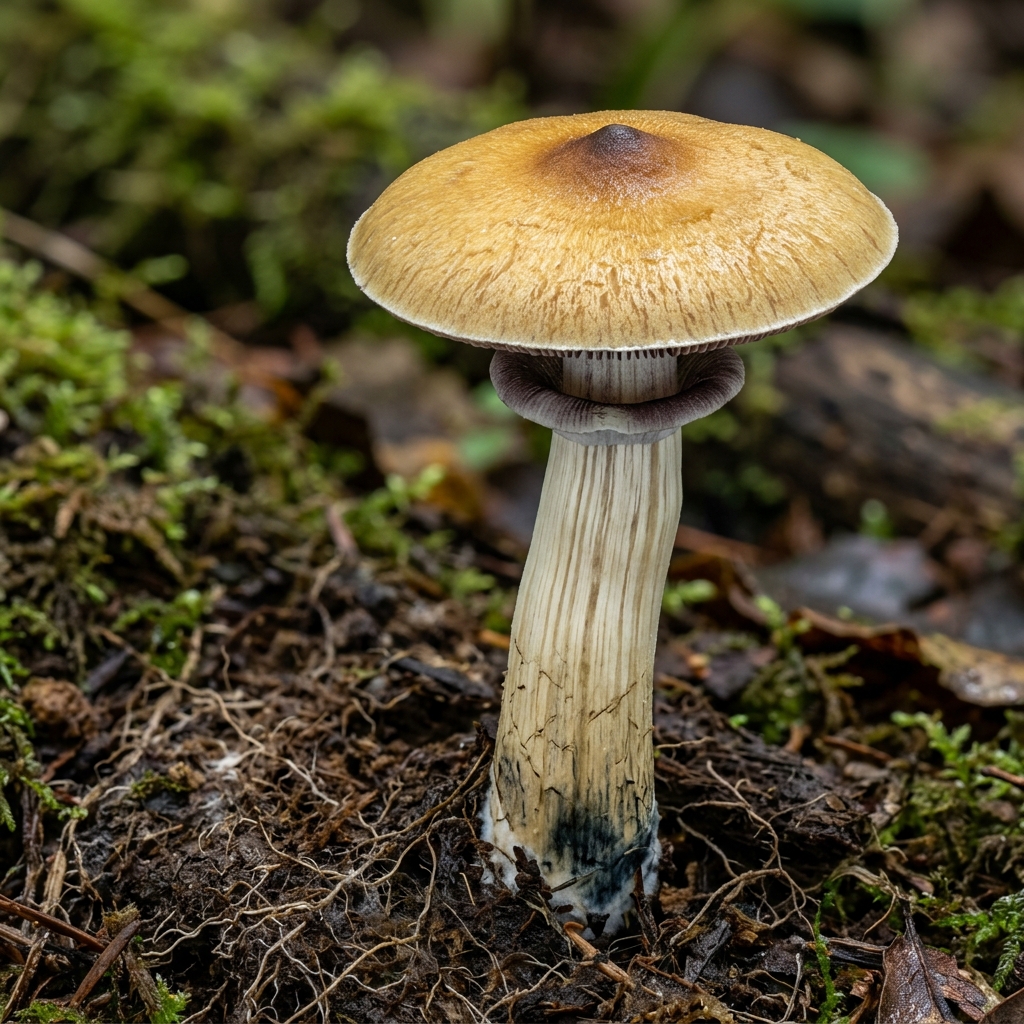
Morphology and Mutations
Cap (Pileus): Cap with a characteristic large diameter, bright golden or ashy yellow color that fades towards the margins.
Stipe (Stem): Robust, elegant stipe, ivory in color with marked longitudinal striations.
Spores: Moderate to high sporulation, dark purplish-brown spores.
Genetic Traits: Morphological symmetry, Phenotypic stability, Synchronous development
Cultivation Characteristics
Special Requirements: It prefers substrates supplemented with composted equine or bovine manure, although it adapts well to coconut fiber (coir). It fruits best with a well-defined photoperiodic lighting regimen to guide the phototropism of the basidiocarp.
Effects and Psychopharmacology
- Mood enhancement
- Augmented tactile perception
- Warm colors
History and Description
Appearing in mycological literature and spore catalogs around the 1980s, the Golden Teacher is a classic isolation revered for both its elegant aesthetics and consistent alkaloid profiles. The "Teacher" suffix was taxonomically coined by the ethnobotanical community to describe its alleged cognitive and introspective effects, anecdotally reported as less chaotic and more didactic than other strains. Biologically, it is distinguished by remarkable genetic stability resulting in phenotypically uniform colonies. Fruiting bodies tend to mature slightly slower than more aggressive varieties, allowing for dense somatic development.
The Golden Teacher variety has an extensive history in modern mycology, being appreciated for its unique genetic profile and its contribution to fungal biodiversity studied in laboratories worldwide.