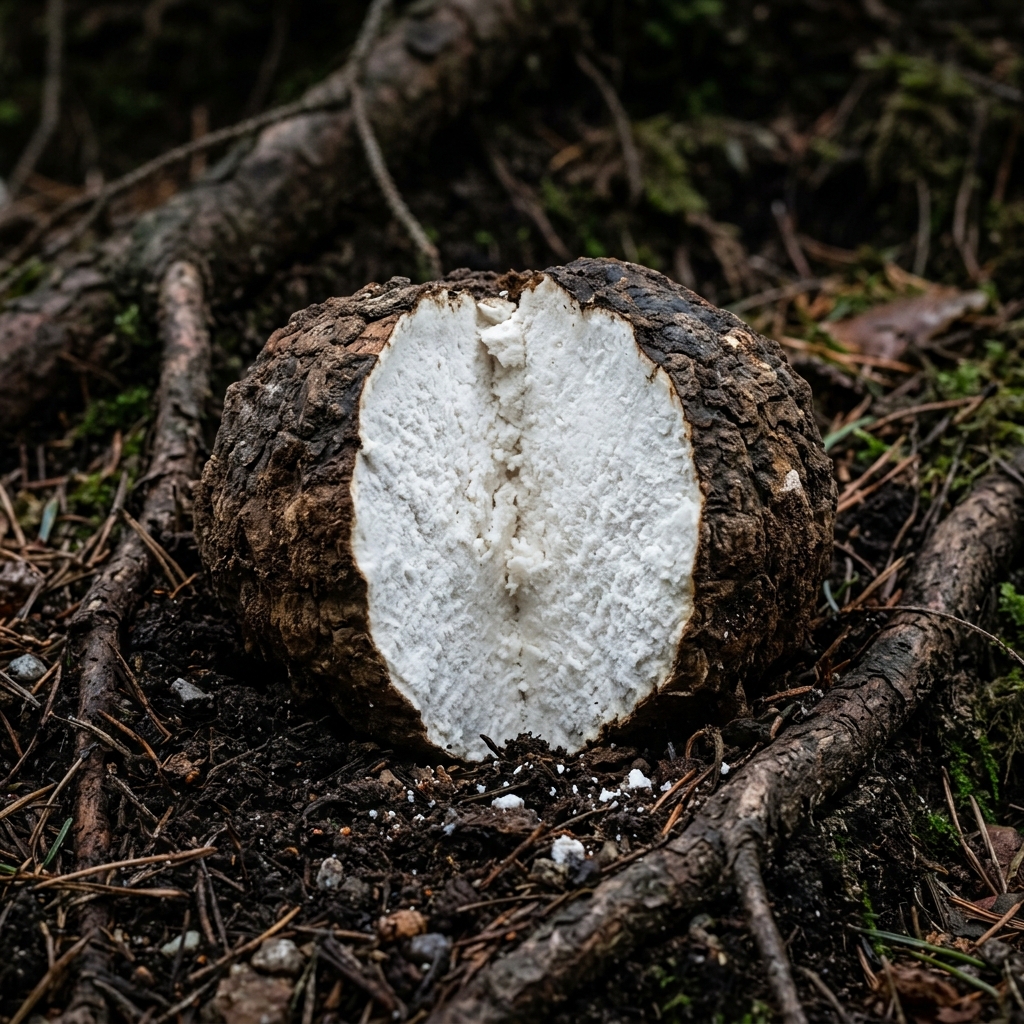
Poria cocos (Wolfiporia extensa), historically known to Native Americans as “Tuckahoe” and in Asia as “Fúlíng,” defies the classic idea of what a mushroom is. Instead of a delicate cap above ground, Poria is a massive subterranean block—a survival “battery” (sclerotium) attached to pine roots that resembles a giant black truffle. When cut open, it reveals a white, chalky, and dense interior.
Its potato-like appearance hides a medical titan. It is an ingredient so absolutely fundamental in the Asian pharmacopeia that it forms the basis of countless clinical prescriptions, especially for two seemingly disconnected purposes: the kidneys and the mind. Chemically, its pachymic acid acts as a master diuretic, purging fluid retention without the harsh mineral impact of synthetic drugs. Simultaneously, it has a documented ability to bind with the brain’s GABA receptors, serving as a natural sedative and anti-anxiety agent that targets the root causes of insomnia and nervous palpitations.